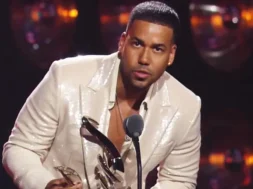
When Romeo Santos stepped onto the stage at Premio Lo Nuestro, the atmosphere carried more than celebration. In the days leading up to the ceremony, a clip from a recent interview circulated widely online in which Romeo said he believes artists should focus on music and avoid getting involved in politics. The comment sparked immediate debate across social media, talk shows, and fan communities.
By the time he reached the microphone, it was clear many were waiting to hear whether he would double down, clarify, or walk back his position.
What Romeo Said
During his speech, Romeo addressed the controversy directly.
“I never said I don’t care about what’s happening in our communities. What I said is that my platform is music. My responsibility is to create art that heals, that inspires, that unites.”
He continued:
“Not every artist is meant to be a political spokesperson. Some of us speak through melodies, through stories, through emotion. That doesn’t mean we’re silent. It means we choose a different language.”
He closed the segment with:
“If my songs have helped you feel seen, loved, or understood, then I’ve done my part.”
The speech was measured. Calm. Intentional. It did not attack critics, nor did it fully retreat from his original stance.
The Supporters: Understanding His Position
Many fans and fellow artists defended Romeo, arguing that his statement was taken out of context. Supporters emphasized that not every public figure is equipped, informed, or positioned to engage in political discourse. They point out that forcing artists to comment on every issue can lead to performative activism rather than meaningful change.
For them, Romeo’s catalog speaks for itself. His music has long explored themes of love, heartbreak, migration, longing, and identity. While not overtly political, his work has resonated deeply with Latino communities navigating life in the United States. Supporters argue that there is power in emotional storytelling and that art itself can be a form of social contribution.
Some also noted that in today’s hyper-polarized climate, remaining focused on craft can be a conscious choice to avoid deepening divisions.
The Critics: Calls for Accountability
Others were not satisfied.
Critics argue that artists of Romeo’s stature benefit from platforms built by communities directly affected by political decisions. They believe that choosing not to engage publicly can feel like distancing oneself from issues that impact fans’ daily lives.
For them, neutrality can be perceived as privilege. Especially in moments of social tension, they argue that silence or avoidance carries weight. Some felt his initial comment minimized the role artists have historically played in movements for justice, particularly within Latin music traditions that have included protest, social commentary, and cultural resistance.
While many acknowledged his clarification at Premio Lo Nuestro, they still expressed a desire for more direct acknowledgment of specific issues affecting Latino communities.
The Middle Ground: A Complex Conversation
There is also a middle perspective emerging. Some fans believe both ideas can coexist. Artists should not be forced into political commentary, yet they also cannot ignore the influence they hold.
This group sees Romeo’s speech as an attempt to define boundaries rather than escape responsibility. They interpret his words as saying that activism can take many forms, and that his chosen medium is music. At the same time, they understand why fans crave visible solidarity during uncertain times.
The broader debate raises a larger question about celebrity culture in 2026: Are artists obligated to be activists? Or is their primary duty to their art?
The Bigger Picture
Romeo’s speech did not fully end the conversation, but it reframed it. By stating, “My responsibility is to create art that heals,” he positioned himself as an artist first, not a political commentator. Whether that satisfies everyone is another matter.
What the moment at Premio Lo Nuestro made clear is this: audiences today expect more than entertainment. They expect awareness, alignment, and sometimes advocacy. But how each artist responds to that expectation will vary.
In addressing the backlash directly, Romeo chose dialogue over silence. For some, that was enough. For others, the conversation continues.
And perhaps that ongoing conversation is the real story.