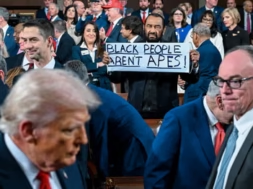
Last night during the State of the Union, the annual Joint Session of Congress where the president speaks directly to lawmakers and the nation, Al Green was escorted out of the House chamber after he stood up holding a cardboard sign that said “BLACK PEOPLE AREN’T APES!” The message was not random and it was not a stunt for attention. It was a direct confrontation with racist imagery that had circulated in political spaces in the days leading up to the speech. According to reporting from The Washington Post, Green stood as President Donald Trump entered the chamber and held the sign high enough for cameras to capture it. Security officials quickly approached him and he was removed for violating House decorum rules that prohibit demonstrations and signage during formal proceedings.
Joint Sessions are tightly controlled and highly choreographed. Members are expected to remain seated, follow procedural norms, and avoid visible protest. The purpose of the event is to project institutional stability and unity. By standing and displaying that message, Green disrupted that image. Under House rules, that disruption alone is grounds for removal. But focusing only on decorum leaves out why he chose that moment.
The phrase on the sign speaks to one of the oldest racist tropes in American and Western history. Comparing Black people to apes has long been used as a tool of dehumanization. Green made it clear to reporters afterward that his intention was to confront that language directly and publicly. He said he wanted the president and the country to see that message and understand that such rhetoric cannot be normalized. He stated that he felt compelled to stand up because remaining silent would have felt like acceptance.
Other Democratic lawmakers responded to the broader controversy as well. Alexandria Ocasio-Cortez has previously spoken about the dangers of normalizing racist rhetoric in political discourse, emphasizing that silence in powerful spaces can reinforce harm. Jasmine Crockett has also been vocal in calling out racially charged language and has argued that confronting it directly is part of a lawmaker’s responsibility. While their responses to this specific moment continue to unfold publicly, both have consistently framed these issues as matters of dignity and accountability rather than partisan theater.
Critics argue that formal proceedings are not the place for protest and that rules exist to maintain order. They say once decorum is broken, the institution risks sliding into constant disruption. Supporters counter that decorum has historically been used to quiet uncomfortable truths and that challenging dehumanizing rhetoric inside the chamber is not chaos but conscience.
Green understood that holding up that sign would likely result in removal. The action was calculated. It was meant to interrupt the smooth, carefully managed optics of the evening and force a confrontation with language that many believe should never be tolerated in the first place. Whether one views it as a breach of procedure or a necessary stand, the moment underscored a deeper tension in American politics about when order protects democracy and when it protects power.